
Plan a trip from Seoul through Gyeongju to Busan and you end up with three booking tabs open: Korail’s site, a bus booking site, and a travel platform selling the KORAIL PASS. The pass listing still carries a line saying “SRT (starting from Suseo station)” is not included, and it is easy to assume the bus is the cheap option. Then you see the price of a 2-day pass and start counting how many rides it takes to break even.
That sum changed in September 2026. When Korea’s two high-speed rail operators merged, KTX fares fell by 10% on average. On the morning of Wednesday 14 October, a standard seat on an undiscounted KTX from Seoul Station to Busan on the high-speed line cost ₩53,400 to ₩53,900. Divide the KORAIL PASS by its days and even the cheapest, the 5-day pass, costs ₩55,000 a day. One day of the pass now costs more than the longest ticket on this line. Any day with a single ride loses you money.
So my advice is simple. If you are moving one way, Seoul to Gyeongju and then Gyeongju to Busan, skip the pass and buy single KTX tickets. Pick Seoul Station or Suseo by whichever is nearer your hotel, and consider the bus only for the ride to Gyeongju. Here are the numbers behind that.
One pass day costs more than the longest ticket
The KORAIL PASS is a rail pass sold only to foreign visitors. Korean nationals cannot buy it, and you need a passport and a credit card to buy one. You choose 2 to 5 travel days within 10 days of the start date. Adults (13 and over) pay ₩131,000 for 2 days, ₩186,000 for 3, ₩234,000 for 4 and ₩275,000 for 5.
Per day, that is ₩65,500 on the 2-day pass, ₩62,000 on the 3-day, ₩58,500 on the 4-day and ₩55,000 on the 5-day. The most expensive ticket on this corridor is Seoul–Busan; Seoul–Gyeongju is ₩44,100 on most trains and Gyeongju–Busan ₩10,100. On a day with one ride, the pass never earns back its daily cost.
I priced five common itineraries with adult standard-class fares I looked up on 7 October. For Seoul–Busan I used ₩53,700, the middle of the ₩53,400–53,900 range for undiscounted trains on the high-speed line, and I counted one pass day for every date with a train ride.
| Itinerary | Rides and pass days | Single tickets | Pass | Pass saves |
|---|---|---|---|---|
| Seoul → Busan, later Busan → Seoul | 2 rides, 2 days | ₩107,400 | ₩131,000 | −₩23,600 |
| Seoul → Gyeongju → Busan → Seoul, one leg a day | 3 rides, 3 days | ₩107,900 | ₩186,000 | −₩78,100 |
| Seoul → Gyeongju → Busan, fly home from Busan | 2 rides, 2 days | ₩54,200 | ₩131,000 | −₩76,800 |
| Seoul → Busan, KTX day trip to Gyeongju from Busan, Busan → Seoul | 4 rides, 3 days | ₩127,600 | ₩186,000 | −₩58,400 |
| A same-day return from Seoul to Gyeongju, another to Busan | 4 rides, 2 days | ₩195,600 | ₩131,000 | ₩64,600 |
Seoul–Gyeongju is priced at ₩44,100, the fare on most trains. A few trains are ₩44,200. Very early and very late trains sometimes show 15–25% off. Choose one of those and single tickets win by even more.
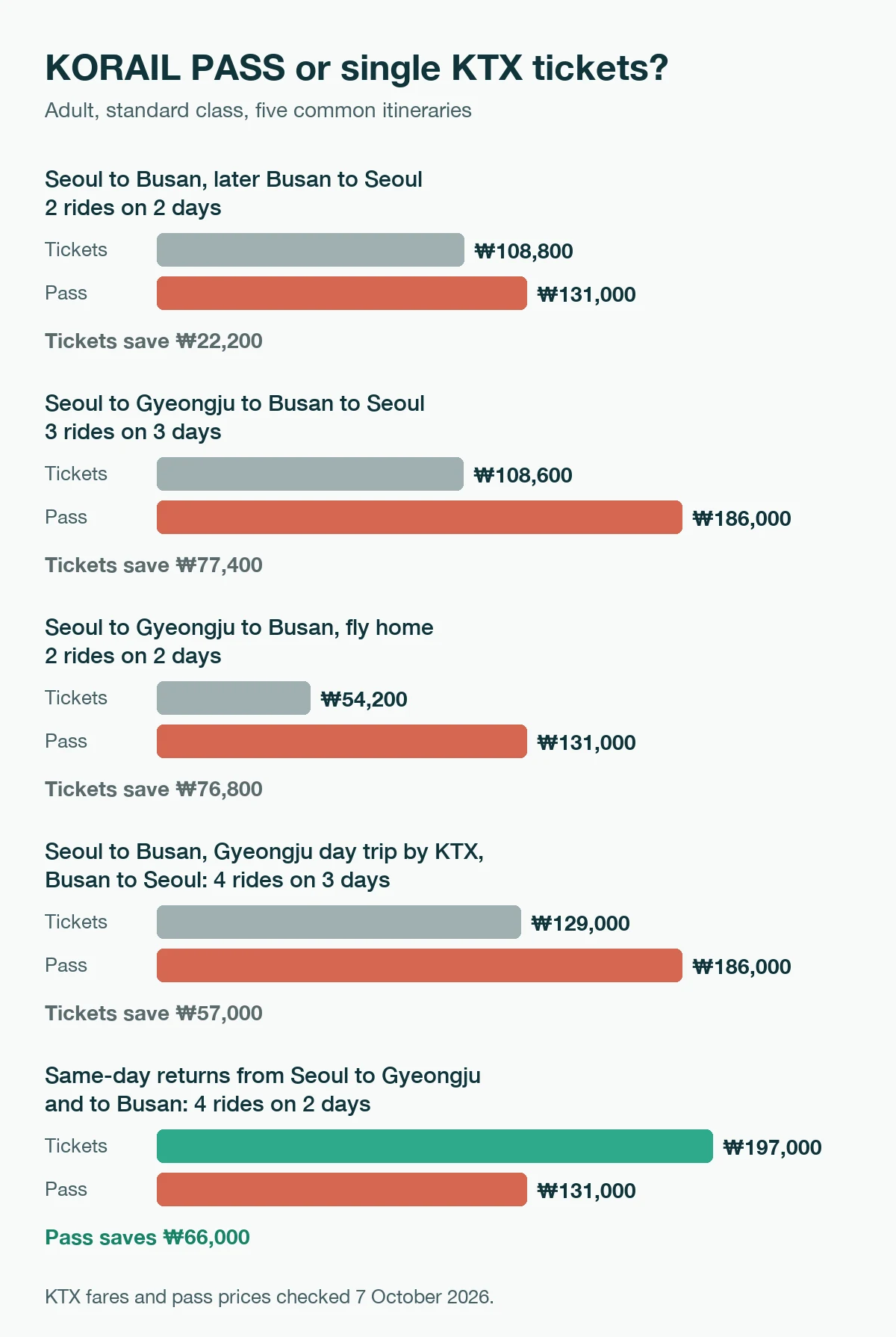
The pass wins only in the last row. If you base yourself in Seoul and do two long day trips, each of those days has two long rides, and that beats the daily cost. A plan that adds train trips to other regions is also worth pricing again. For a trip that passes through Gyeongju and Busan once, leave the pass out. The ₩78,100 in the second row is better spent on another night in Gyeongju.
I would not add day trips just to fill the spare days on a pass. A Seoul–Gyeongju return puts you on a train for over four hours, and that comes straight out of your time in Gyeongju. Whether Gyeongju deserves a day or a night is worked out in our guide Seoul to Gyeongju by KTX: day trip with the night view, or one night?.
If you are still leaning toward the pass, read three rules first. First, pass holders can reserve seats only from one month before departure, while ordinary tickets go on sale two months ahead at 07:00. On busy dates, pass holders join the queue a month late. If seats are gone you may ride standing with the pass and your passport, and you can reserve at most two seats a day.
Second, first class costs extra: Korail’s pass page says pass holders booking first class are charged 50% of the first-class price for that route. Third, the pass cannot be refunded once its start date arrives. If your plans might change, single tickets give you more room.
Suseo is still a grey area. Since 1 September 2026 the former SRT trains have run as KTX-Sancheon within the KTX system. On 7 October, Korail’s pass page listed the metropolitan railway and temporary tourist trains as excluded and said nothing about Suseo. The same day, Klook’s KORAIL PASS listing still named “SRT (starting from Suseo station)” and first class among the things not included. On pass days, I would leave from Seoul Station, which neither set of rules excludes.
You buy the KORAIL PASS in won on Korail’s site for foreign visitors. For a plan like the last row, you can also buy the KORAIL PASS on Klook and pay in your own currency. On 7 October an adult 2-day pass was US$107.59 and a 3-day pass US$152.79, with a full refund if you cancel by 17:00 Korea time the day before the start date.
Seoul Station or Suseo: since September, your hotel decides
Until August 2026, two companies ran the high-speed trains from Seoul to Busan: Korail’s KTX from Seoul Station, and SR’s SRT from Suseo in southeast Gangnam. On 1 September they became one. The SRT trains were renamed KTX-Sancheon, and KTX fares came down to the old SRT level, about 10% lower on average. Korail’s announcement put Seoul–Busan at ₩54,400, down from ₩59,800. When I looked up trains for the morning of 14 October, undiscounted trains on the high-speed line showed slightly less, ₩53,400 to ₩53,900.
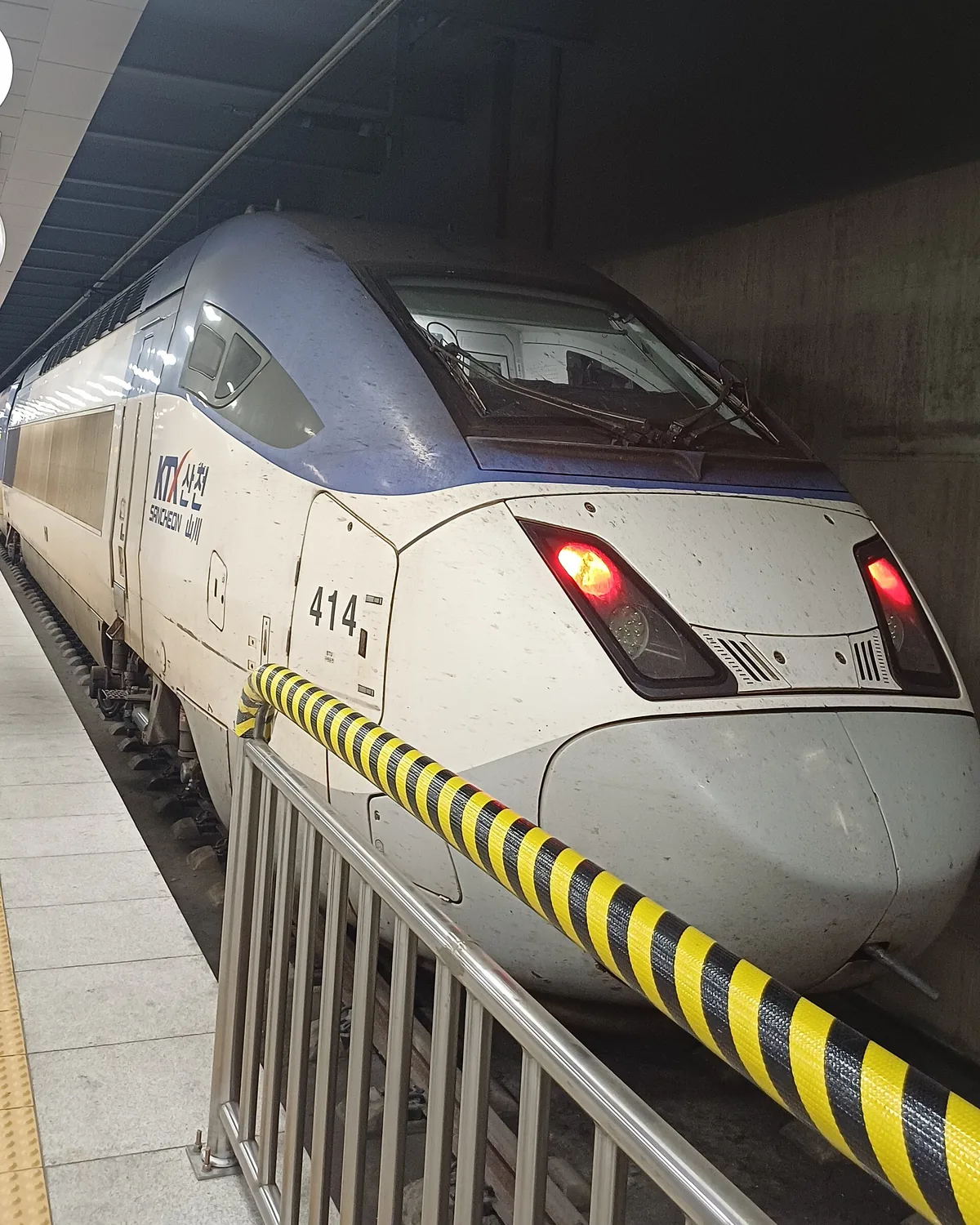

For travellers, the change is one booking system. Trains from both Seoul Station and Suseo show up together on Korail’s site and the Korail+ app. So choose the station by where you sleep. Seoul Station is in central Seoul; Suseo is in southeast Gangnam. On Klook’s listing for same-day departures on 7 October, Suseo–Busan trains were about a dollar cheaper than Seoul Station ones.
On the morning of 14 October, KTX trains on the high-speed line from Seoul Station to Busan took 2 h 18 min to 2 h 51 min. Trains that stop at Suwon or run via Gupo take over three hours and cost a little less, ₩47,400 to ₩48,600. If you are not in a hurry, they are an option.
Korail has said it must keep these fares for at least three years. That minimum was set during the merger review, and Korail says nothing has been decided about rolling fares back after it ends.
After the October rise, a Premium bus costs more than the KTX
Plenty of advice says to take the express bus if train fares are a stretch. Express and intercity bus fares went up by about 9% on average from 1 October 2026, and that changed the comparison.
From Seoul Express Bus Terminal (Gyeongbu Line) on Wednesday 14 October, an Excellent-class seat to Busan cost ₩43,300 and a Premium seat ₩56,200. To Gyeongju, Excellent was ₩36,700 and Premium ₩47,700. On both routes, a Premium bus now costs more than a standard KTX seat. The cheapest regular coaches (₩29,100 to Busan, ₩24,700 to Gyeongju) run only a few times a day, all in the evening. On 14 October they left for Busan at 17:20, 18:20 and 20:40, and for Gyeongju once, at 17:10.
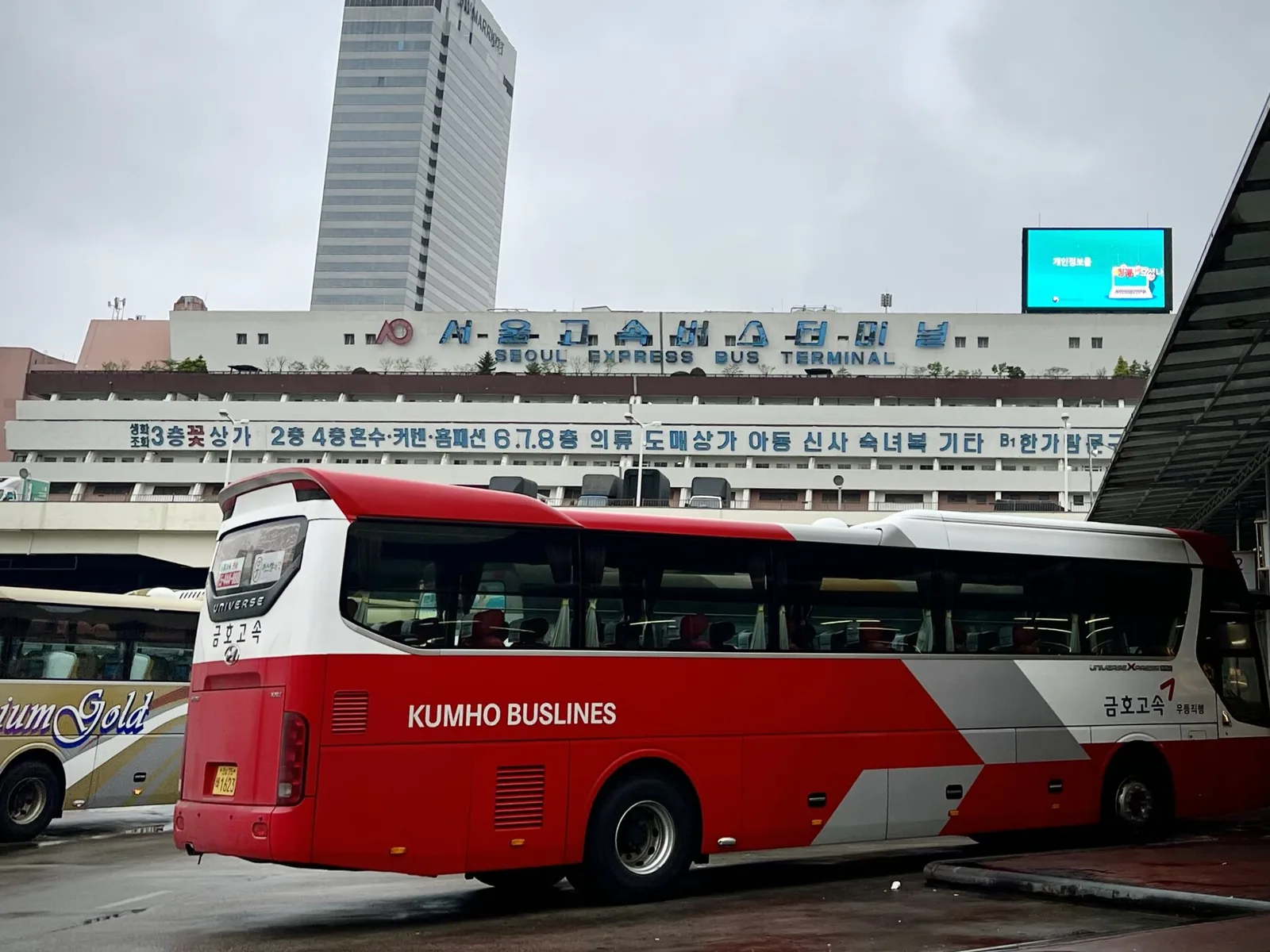

To Busan there is little reason to take the bus. Excellent class saves you about ₩10,000 over the KTX, but the timetable allows four hours. That is over an hour longer than a KTX of about two and a half hours, and the bus stops at the terminal in Nopo, at the far north end of Busan. If you are staying near Busan Station or in Haeundae, you still have a long way to go.
Gyeongju is different. Gyeongju Station, where the KTX stops, is 7 km from the centre in a straight line. After about two hours from Seoul Station, you still need a city bus of about 30 minutes into town. The express bus takes 3 h 30 min, but it stops at Gyeongju Express Bus Terminal in town, within walking distance of Hwangnidan-gil. Depending on how long you wait for the city bus, the difference is between ten minutes and an hour, and the Excellent fare is ₩8,850 less than the KTX plus the city bus. If you are dragging a large suitcase, a ride with no change may well be the easier one.
Saturday mornings, though, can fill early on both. When I checked on 7 October for Saturday 17 October, ten days out, every KTX from Seoul Station to Gyeongju between 06:33 and 11:58 was sold out. Only the 05:13 and 05:27 had seats. The express buses to Gyeongju at 06:50, 08:10, 09:00 and 10:10 that day had no seats left either; the 11:10 was the first with space. For that Saturday, ten days ahead was already too late. If you are heading to Gyeongju on a weekend morning, buy the ticket as soon as the date is fixed.
Bus tickets are hard to buy ahead with a foreign card. Since 24 February 2026, Kobus, the express bus booking site, has not accepted card numbers typed in by non-members. I would buy at the terminal, from the counter or a machine. If you want a seat secured in advance, an agent such as Klook’s Seoul–Gyeongju express bus tickets lets you pay with your own card. Compare the total with the won fares above before you pay.
From Gyeongju Station, allow a 30-minute bus into town
Gyeongju Station, where the KTX stops, was called Singyeongju Station until 28 December 2023. Older maps and guides still use the old name. From the station to the bus terminals in town is about 7 km in a straight line and 10.7 km by bus.
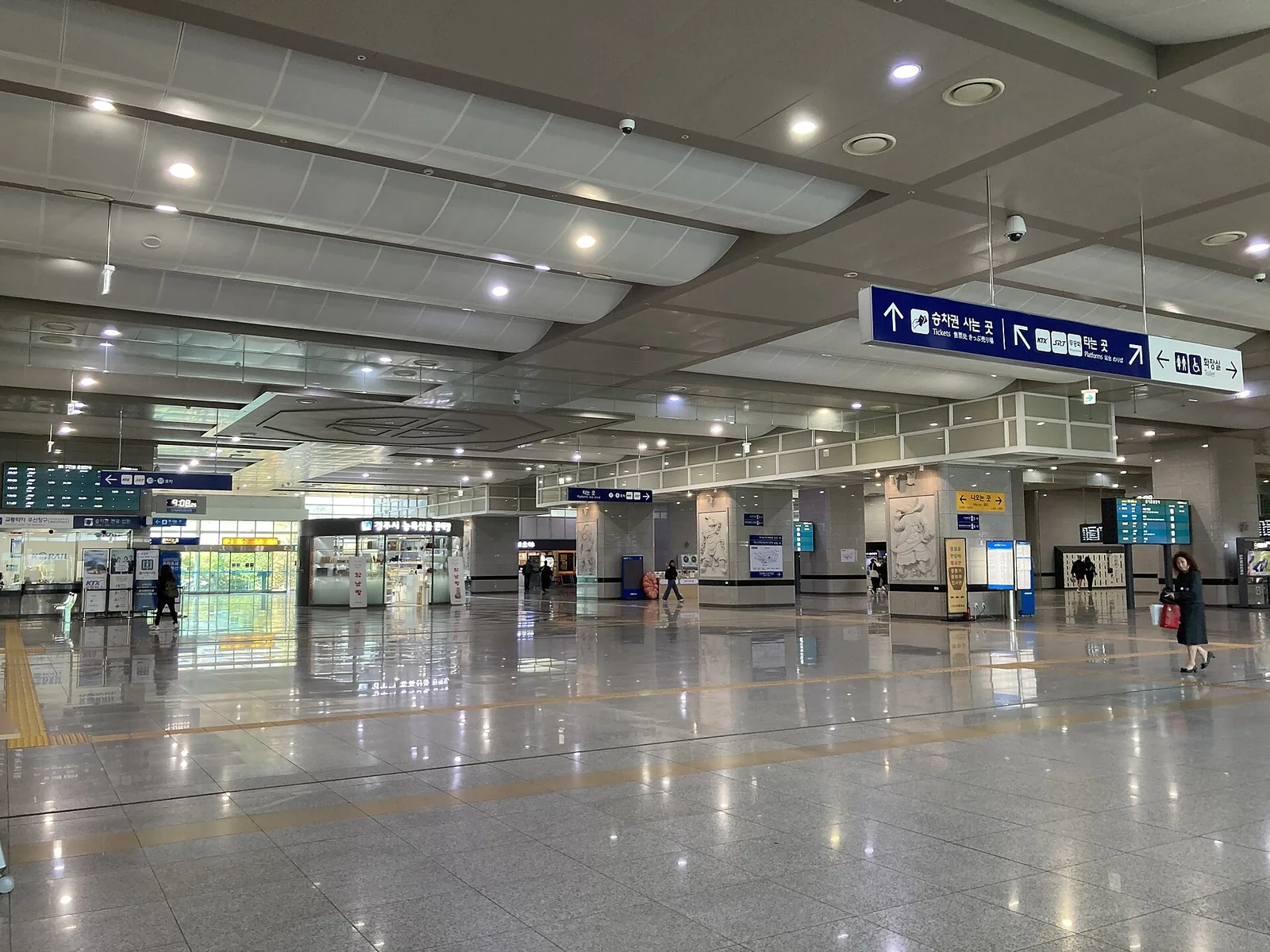

Take bus 50, 51 or 70 into town. All three leave the station from about 05:00 to about 23:00, no more than 25–30 minutes apart, and pass both bus terminals and Hwangnidan-gil. The fare is ₩1,500 in cash or ₩1,450 with a transport card, and a transfer within 30 minutes is free.
A taxi costs more than the distance suggests. Since 1 February 2026 the meter starts at ₩4,500, and Gyeongju Station lies more than 5 km from the city centre, inside the surcharge zone. The city estimated about ₩20,000 from the station to the bus terminal or Hwangnidan-gil. For going straight to Bulguksa, see our guide to Bulguksa and Seokguram by bus.
Between Gyeongju and Busan: check which side your hotel is on
Gyeongju and Busan are about 30 minutes apart by KTX. On Wednesday 14 October, more than 30 KTX trains ran from Busan Station to Gyeongju Station between 05:19 and 22:16, taking 27 to 35 minutes, and most cost ₩10,100 in standard class. The last train the other way leaves Gyeongju Station at 23:46 and reaches Busan Station at 00:13. If you are staying near Busan Station or Nampo-dong, this is the simplest option.
If you are staying in Seomyeon, Bujeon Station is closer. From Bujeon to Gyeongju Station, the KTX-Eum takes a little over an hour for ₩12,500, and the ITX-Maum about an hour and a half for ₩10,100. Either way, add 30 minutes from Gyeongju Station into town.
To leave straight from central Gyeongju, buses run from the town’s bus terminal to Nopo (Busan Dongbu) in north Busan and to Haeundae. If you go that way, buy your return ticket as soon as you arrive in Gyeongju. A traveler who did a weekday day trip from Busan and posted about it in Traditional Chinese on 19 April 2026 wrote in a September reply that the tickets for the last express buses back had sold out, so they took an Uber to Gyeongju Station and caught the KTX. KTX trains leave Gyeongju Station late into the evening, so even if the buses are gone, there is a way back if you accept the taxi fare.
Booking from abroad: Korail’s site, cards, and the fallback
Book on Korail’s site for foreign visitors. On 7 October the old address, letskorail.com, led to korail.com, where you can choose English, Traditional Chinese and other languages. When you buy, you set an email address and a password, and you use those two to find the ticket later. They must match exactly, including upper and lower case, so write them down. You pay by credit card.
When sales open. Tickets go on sale at 07:00 Korea time two months before the travel date. The window grew from one month to two on 1 October 2026.
If your card will not go through. In February 2025 someone posted on Dcard, the Taiwanese forum, that they entered a JCB card number and the verification code to buy KTX tickets and got only a blank white window, with no charge on the card. One reply suggested trying Visa, but another said Visa and Mastercard did the same, and a third bought on Trip.com in the end. If a couple of cards fail, do not keep fighting it; move to an agent.
If the site will not load. In September 2026 a Reddit post reported that korail.com and the app would not open. The poster found the site worked on their hotel Wi-Fi, and replies suspected trouble with access from overseas IP addresses. In October another traveler replied that, booking from abroad, they turned off Wi-Fi and their VPN, switched to mobile data, and could see tickets again. If the site will not load, try a different network first.
If that fails, use the platforms Korail sells through. Korail has sold tickets through Trip.com since 2018 and through Klook since March 2026. You can search Seoul–Busan KTX trains on Klook or Seoul–Gyeongju trains and pay in your own currency. On Klook’s listing for same-day departures on 7 October, most KTX trains from Seoul Station cost in the US$41 range to Busan and US$33–34 to Gyeongju. Klook’s own refund rules apply: ₩400 a ticket up to two days before, 5% the day before, 10% from then until three hours before, 20% in the last three hours, and no refund after departure. Avoid unofficial resale sites such as RailNinja and RailMonster, which Korail has named in a warning. In Korail’s example, a Seoul–Busan ticket that cost about US$43 on its own site sold there for US$76.
After you buy. A screenshot is not a valid ticket. Show the ticket opened on the website or in the app. Luggage is limited to two pieces you can carry yourself, kept clear of seats and aisles. Tickets bought from Korail for Monday to Thursday trains can be cancelled free until three hours before departure. For Friday to Sunday and public holiday trains a minimum fee applies from the start, rising to 5% the day before, 10% from 24 hours before and 20% in the last three hours.
So, how to go
If you travel one way, Seoul to Gyeongju and then Gyeongju to Busan, buy single KTX tickets. Seoul–Gyeongju at ₩44,100 plus Gyeongju–Busan at ₩10,100 comes to ₩54,200. Even with a return from Busan to Seoul, the total is ₩107,900, ₩78,100 less than a 3-day pass.
For the ride to Gyeongju alone, an Excellent-class express bus is a fair choice. It drops you in town and costs ₩8,850 less than the KTX plus the city bus. For Busan, take the KTX. Since the October rise, a Premium bus costs more than the train.
Bring out the pass when you base yourself in Seoul and take two or more long day trips. Even then, remember that pass holders reserve seats only a month ahead, and that on Saturday 17 October the morning trains to Gyeongju had sold out ten days before.
KTX fares and times are for trains on Wednesday 14 and Saturday 17 October 2026, looked up on 7 October. Bus fares are what Kobus listed for 14 October after the 1 October rise.
Put these notes into a Seoul 2-day itinerary →
Sources & verification
A source-based guide. Check the linked operator information again before you travel.
- Korail: High-speed rail integration from 1 September 2026, fares and services (press release, 5 August 2026)Sources checked:
- Korail: What changed after the integration (18 September 2026)Sources checked:
- Korail: Statement on the integrated KTX fare and its three-year minimum (7 August 2026)Sources checked:
- Korail ticket search: Seoul, Busan, Bujeon and Gyeongju trains for 14 and 17 October 2026Sources checked:
- Korail for foreign visitors: Ticket reservation (two-month booking window from 1 October 2026)Sources checked:
- Korail for foreign visitors: Tickets, payment and refund penaltiesSources checked:
- Korail for foreign visitors: FAQSources checked:
- Korail for foreign visitors: About the KORAIL PASSSources checked:
- Korail for foreign visitors: Carry-on luggage rulesSources checked:
- Korail notice: Beware of unauthorized train ticket websites (18 August 2025)Sources checked:
- Korail: Ticket sales contract with Klook, from March 2026 (24 October 2025)Sources checked:
- Kobus: Express bus timetable and fares, Seoul to Busan and Gyeongju (14 and 17 October 2026)Sources checked:
- Kobus notices: Express and intercity fare adjustment (22 September 2026); non-member card payment stopped from 24 February 2026Sources checked:
- Bustago: Intercity bus fare rise notice (8 September 2026)Sources checked:
- Bustago: Intercity bus timetables, Busan Dongbu (Nopo) and Haeundae to and from GyeongjuSources checked:
- Klook: KORAIL PASS, prices, exclusions and cancellationSources checked:
- Klook: Korea rail search, Seoul to Busan and Seoul to GyeongjuSources checked:
- Gyeongju City: Singyeongju Station renamed Gyeongju Station (28 December 2023)Sources checked:
- Gyeongju City Transport Information Center: Bus routes and timetablesSources checked:
- Gyeongju City Transport Information Center: Bus faresSources checked:
- Gyeongju City: Taxi fares from 1 February 2026Sources checked:
- Gyeongbuk Shinmun: Gyeongju taxi fare rise and Gyeongju Station surcharge (January 2026)Sources checked:
- Dcard: KTX card payment with JCB shows a blank window (February 2025)Sources checked:
- r/koreatravel: Korail.com / app not working? (September 2026)Sources checked:
- Threads: Busan to Gyeongju day trip, last buses back sold out (April 2026, reply September 2026)Sources checked:
Help us keep this note useful
A quick response helps us decide what to clarify or recheck. No account or email is needed.